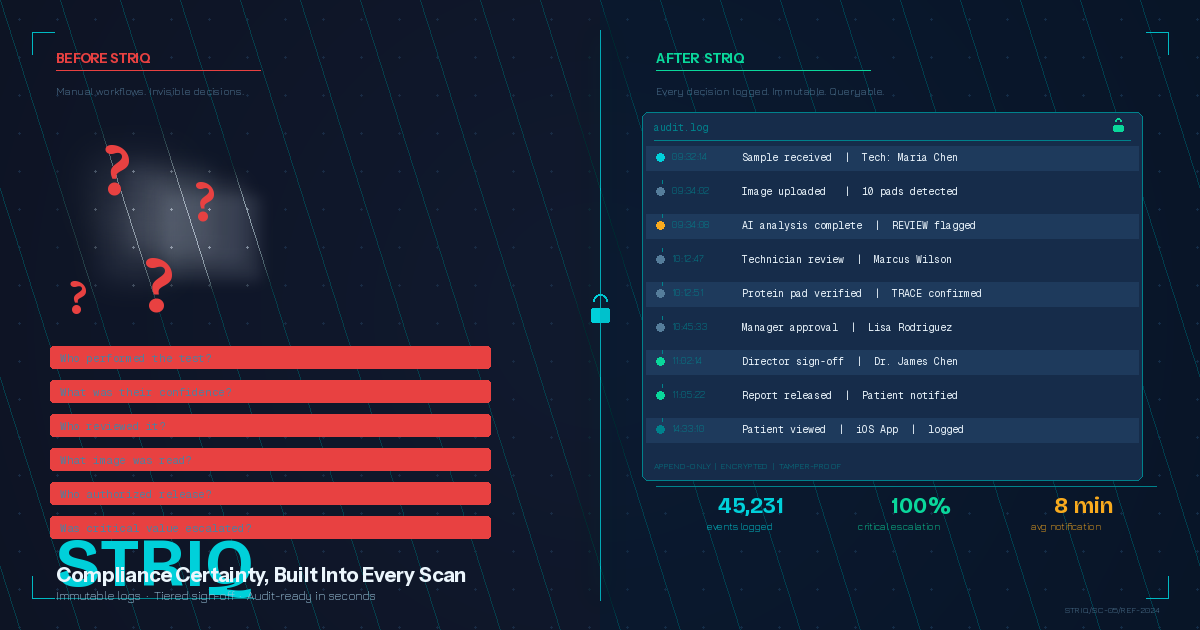
The Compliance Nightmare: Certainty Is Invisible
You run a diagnostic lab. A patient's test result comes back abnormal. The patient follows up with their doctor. Six months later—or six years—you get a question from an auditor, a lawyer, or a regulator:
"Who performed the urinalysis?" You have a name, maybe.
"What was their confidence in the result?" No data.
"Did anyone review it before release?" You have initials on a report, but no timestamp. No change log.
"What was the exact image that was read?" Lost (or in a file cabinet).
"Who authorized the release, and when?" Not recorded.
"Was there a critical value escalation process?" Not documented.
If you're relying on memory, paper trails, or fragmented spreadsheets, you're not in compliance. And worse, you can't defend a decision you didn't record.
Manual workflows are invisible. That invisibility is expensive—in liability, in audit findings, in patient trust.
The Solution: Immutable Logs, Permanent Records, Zero Ambiguity
STRIQ is built for regulated labs. Every scan, every action, every decision is timestamped, traceable, and immutable:
At sample intake:
Technician logs sample quality (volume, freshness, labeling, lot number).
Timestamp recorded. No edits allowed; only append-only amendments.
At AI analysis:
Image uploaded. YOLO detection, color measurement, CNN inference, color-distance classification all logged.
Per-pad confidence scores stored. Disagreement flags recorded.
Quality verdict (PASS/REVIEW/FAIL) locked.
At technician review:
Technician claims scan from queue. Timestamp recorded.
Technician verifies uncertain pads or accepts AI verdict. All decisions logged.
Retest flagged, escalation noted, comment recorded.
At manager authorization:
Manager reviews technician's submission. Approves or rejects.
Rejection reason logged. Reassignment timestamp recorded.
At director sign-off:
Director grants final authorization. Signature (or MFA confirmation) recorded.
Timestamp of authorization. Reason for any override.
At critical-value escalation:
If result exceeds critical thresholds, system triggers automatic notification.
Notification destination logged. Timestamp logged. Acknowledgment logged.
At patient report release:
Report generated (PDF, on-demand).
Patient notified (SMS/email). Notification sent time logged.
Report viewed by patient (portal). View timestamp logged.
At re-validation or amendment:
Patient requests certified re-validation. New scan performed or old scan re-read.
Both the original and re-validated results stored side-by-side.
Amendment reason logged. Who authorized it. When.
The Audit Trail: Query, Defend, Prove
When an auditor asks "walk me through this result," you don't scramble. You open STRIQ's audit log for that scan and show them:
Sample ID: URN-2024-0001
Patient: Jane Doe | MRN: 8675309
Received: 2024-01-15 09:32:14 UTC | Tech: Maria Chen
Sample quality: Volume adequate | Freshness: <2h | Labeling: correct

Image uploaded: 2024-01-15 09:34:02 UTC | File: scan_001_strip.jpg
YOLO detection: 10 pads identified | Confidence: 0.98
Color measurement: L*a*b* values extracted | White balance: auto-corrected

AI Analysis:
  Leukocytes: CNN=NEGATIVE (0.94), Color=NEGATIVE (0.96) → FUSED: NEGATIVE (0.95)
  Nitrite:    CNN=POSITIVE (0.87), Color=POSITIVE (0.89) → FUSED: POSITIVE (0.88)
  Protein:    CNN=TRACE (0.72),    Color=TRACE (0.74)    → FUSED: TRACE (0.73) [FLAG: <0.75]
  pH:         CNN=6.5 (0.98),      Color=6.5 (0.99)      → FUSED: 6.5 (0.99)
  [... 6 more parameters ...]

Quality Verdict: REVIEW (1 low-confidence pad flagged)
Flagged pads: Protein (0.73 < threshold 0.75)

Technician Review: 2024-01-15 10:12:47 UTC | Tech: Marcus Wilson
Action: Reviewed flagged Protein pad. Agreed with AI (TRACE). Approved submission.
Comment: "Pad color consistent with TRACE. No artifact visible."

Manager Review: 2024-01-15 10:45:33 UTC | Manager: Lisa Rodriguez
Action: Approved technician submission. No escalation needed.

Director Sign-Off: 2024-01-15 11:02:14 UTC | Director: Dr. James Chen
Action: Authorized release. No critical values.
Signature: [MFA confirmation ID: sig_abc123xyz]

Patient Notification: 2024-01-15 11:05:22 UTC
Method: SMS + Patient Portal | Status: Delivered
Notification ID: notif_789def456

Report Released: 2024-01-15 11:05:22 UTC
Report ID: rpt_2024_0001 | Format: PDF + Portal view
Patient viewed report: 2024-01-15 14:33:10 UTC | Device: iOS App
Every row is immutable. Every timestamp is queryable. Every person is accountable.
Real-World Compliance Scenarios
Scenario 1: Auditor Question (During CLIA Inspection)
Auditor: "Can you show me the quality control for urinalysis this quarter?"
Before STRIQ: You spend 2 hours printing QC logs, cross-referencing spreadsheets, trying to reconstruct who did what.
After STRIQ: One report, 30 seconds. QC pass/fail rates by technician, by shift, by day. Trends, anomalies, corrective actions all linked to their audit trail.
Scenario 2: Patient Complaint (Discrepancy Between Labs)
Patient: "Lab A said I have protein. Lab B said negative. Who's right?"
Before STRIQ: You re-read both strips from memory. You get different answers. No one knows why.
After STRIQ: You pull both scan images side-by-side. The AI read them identically. Lab B's technician overrode the AI without logging why. You now have a documented discrepancy, a retraining opportunity, and proof that your lab's AI is consistent—the human reviewer was not.
Scenario 3: Regulatory Change (New Critical-Value Threshold)
New regulation: Glucose ≥ 400 mg/dL must trigger a critical alert within 15 minutes.
Before STRIQ: You update procedure manuals. Technicians should know. You can't verify. You can't audit compliance retroactively.
After STRIQ: You update the rule in STRIQ. Every scan going forward logs whether a critical alert was triggered. You run a historical audit: for the last 12 months, how many times did a critical glucose result occur? Were all of them escalated within SLA? Query: run. Report: instant. Compliance: proven.
Scenario 4: Incident Investigation (Missed Critical Value)
A patient with glucose of 450 mg/dL was released as "normal." Patient presents to ER with severe hyperglycemia. Investigation: what happened?
Before STRIQ: You have a paper report. No timestamp. No escalation log. You can't prove whether the result was wrong or the notification failed.
After STRIQ: You trace the entire audit log. AI reading was correct (450 detected, high confidence). Critical threshold rule was active (≥ 400 triggers alert). Alert was generated (timestamp 11:02:00). Alert was sent to referring physician (notification ID, delivery confirmed). The physician didn't respond. Now you have proof: your lab did its job. The issue was downstream. Patient safety review can focus on physician protocols, not lab procedures.
Compliance Features in Detail
HIPAA Strict Mode
Toggle on HIPAA strict mode at the platform level:
All scans encrypted at rest and in transit
Clinical values masked on non-authorized user views
Append-only audit logs (no deletion, no editing)
Automatic PII redaction on exports
Session lockout after inactivity
Mandatory MFA for director and admin roles
Tiered Access Control
Lab directors see all scans in their lab, full audit trail, compliance reports
Managers see assigned technicians' scans and QC data
Technicians see only their work queue and personal metrics
Patients see only their own results and trends
Platform admins see aggregate metrics, no patient data
Settings Change Audit
When a lab director changes a critical rule (confidence threshold, critical-value alert, SLA time), STRIQ records:
Who changed it (user ID)
What changed (exact diff: old value → new value)
When it changed (timestamp)
Why (free-text reason field; required for changes)
Approval (if multi-step approval needed for compliance)
Dashboard Snapshot (Director / Compliance View)
Lab Compliance Summary
━━━━━━━━━━━━━━━━━━━━━━━━━━━━━━━━━━━━━━━
Period: January 2024

Total scans               1,247
AI PASS (no review)        1,182
AI REVIEW (flagged)        58
AI FAIL (rejected)         7

Technician Compliance
  Avg review time:      12 min (SLA: 30 min) ✓
  Override rate:        2.3% (industry: 5%) ✓
  Retest rate:          1.8% (industry: 2.5%) ✓

Critical Values (7 total)
  Detected & escalated:  7/7 (100%)
  Physician notified:    7/7 (100%)
  Time to notification:  avg 8 min (SLA: 15 min) ✓

QC Compliance
  Monthly QC runs:       16/16 completed
  QC pass rate:         98.2%
  Equipment maintenance: all on schedule

Audit Log Events
  Total events logged:   45,231
  Average log size:      8.2 MB
  Last backup:           2024-01-15 02:00 UTC ✓

Pending Actions
  Technician reviews:    3
  Manager sign-offs:     0
  Director approvals:    0

Settings Changes (Jan)
  Rule updates:         4
  All MFA-authorized:   yes ✓
  Approval trail:       complete
At a glance: you know your lab is compliant. If an auditor asks a question, you can answer with data, not excuses.
Multi-Lab Tenancy: Compliance at Scale
Running five labs? STRIQ maintains complete data isolation while enforcing consistent compliance rules:
Each lab's data is segregated at the database level (no cross-lab queries possible)
Each lab has its own audit logs, role hierarchy, and compliance settings
Platform admins can define platform-wide rules (HIPAA mode, minimum confidence thresholds)
Lab directors customize rules per lab (critical-value thresholds, SLA times)
Aggregate compliance reporting shows all labs side-by-side or individually
Why This Matters
For compliance teams: STRIQ is an audit-in-a-box. Every decision is logged. Every question can be answered with data, not estimates.
For regulators: STRIQ demonstrates that your lab takes quality and traceability seriously. Audit findings drop. Inspection confidence rises.
For directors: You sleep better. You know exactly what happened, when, and who did it. If something goes wrong, you have proof. If something goes right, you have evidence.
For patients: Their trust is earned through transparency. They can see their results, understand why a test took time, request re-validation, and know their data is secure.
CTA
Compliance isn't about paperwork—it's about proof. STRIQ builds the proof into every scan, every decision, every workflow step. Stop guessing about your audit trail. Start proving it.
[Book a demo] [See how it works]