The Multi-Lab Problem: One Platform or Ten Silos?
You've grown. You started with one diagnostic lab. Now you run five—in different cities, serving different physicians, running different equipment, handling different patient volumes.
Your choices:
Option 1: Separate systems
Each lab has its own urinalysis software. Lab A uses one vendor; Lab B uses another. Results:
Five different user interfaces. Technicians transferring between labs are confused.
Five different AI confidence thresholds. Lab A flags low-confidence pads at 0.75; Lab B at 0.70. Same strip, different verdicts.
Five separate audit logs. Compliance audits take five times longer.
Five different training curricula. Hiring standardization is impossible.
Zero cross-lab analytics. You can't see which labs are performing better.
Option 2: One monolithic system
Force all labs into a single configuration. Results:
Lab A's equipment (Brand X strips) doesn't match Lab B's equipment (Brand Y strips). You pick one AI model; the other lab suffers.
Lab A's SLA is 4-hour turnaround; Lab B's is 24-hour. You enforce one SLA; one lab is always failing.
Lab A's peak hours are 9am–12pm; Lab B's are 2pm–5pm. Shift management becomes impossible.
All labs share one database. Privacy and regulatory audits are nightmares. A data breach at Lab A exposes Lab B's data too.
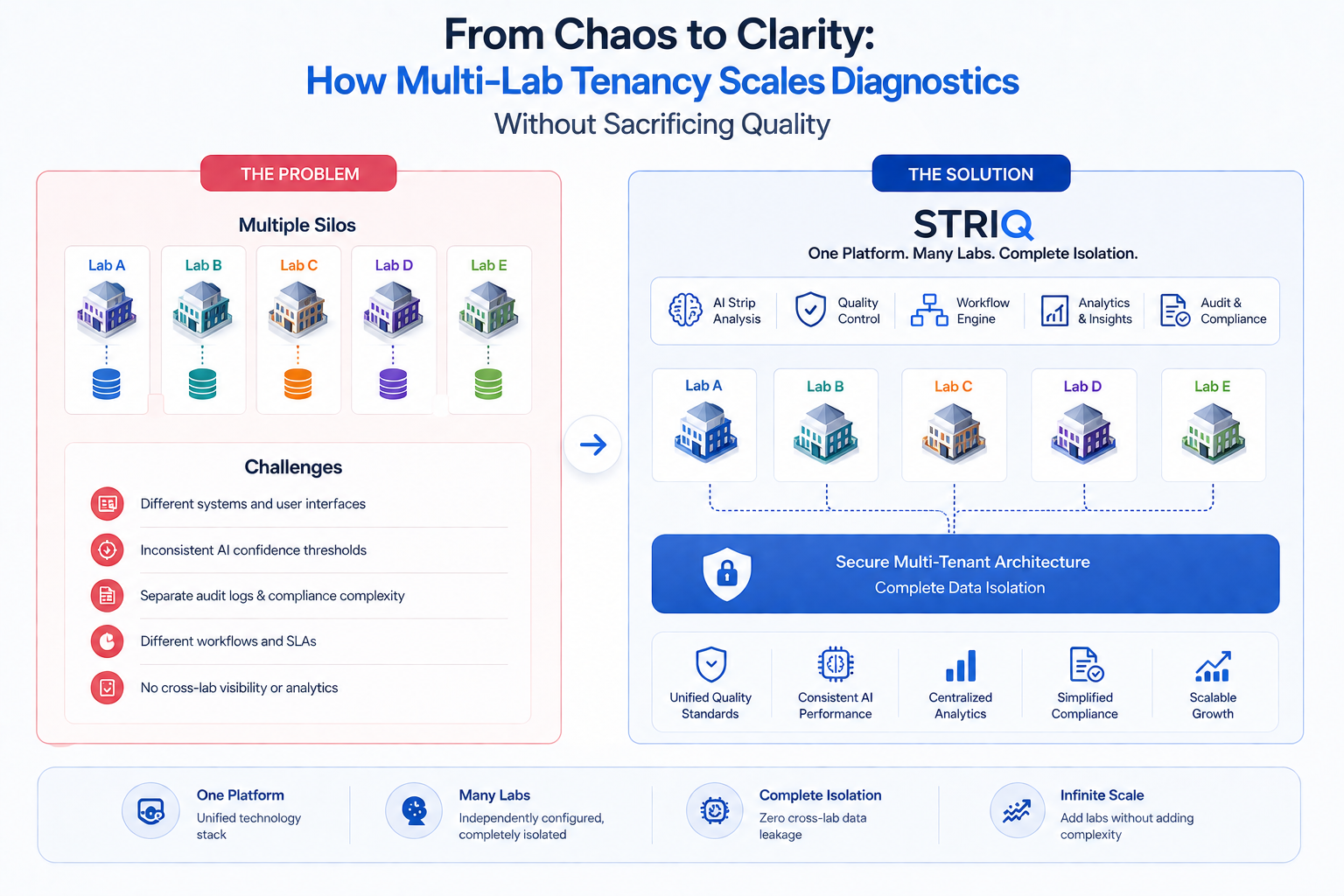
Neither option works. You need one platform with unified quality and analytics, but five independently configured labs with completely isolated data.
The STRIQ Solution: One Platform, Many Labs, Complete Isolation
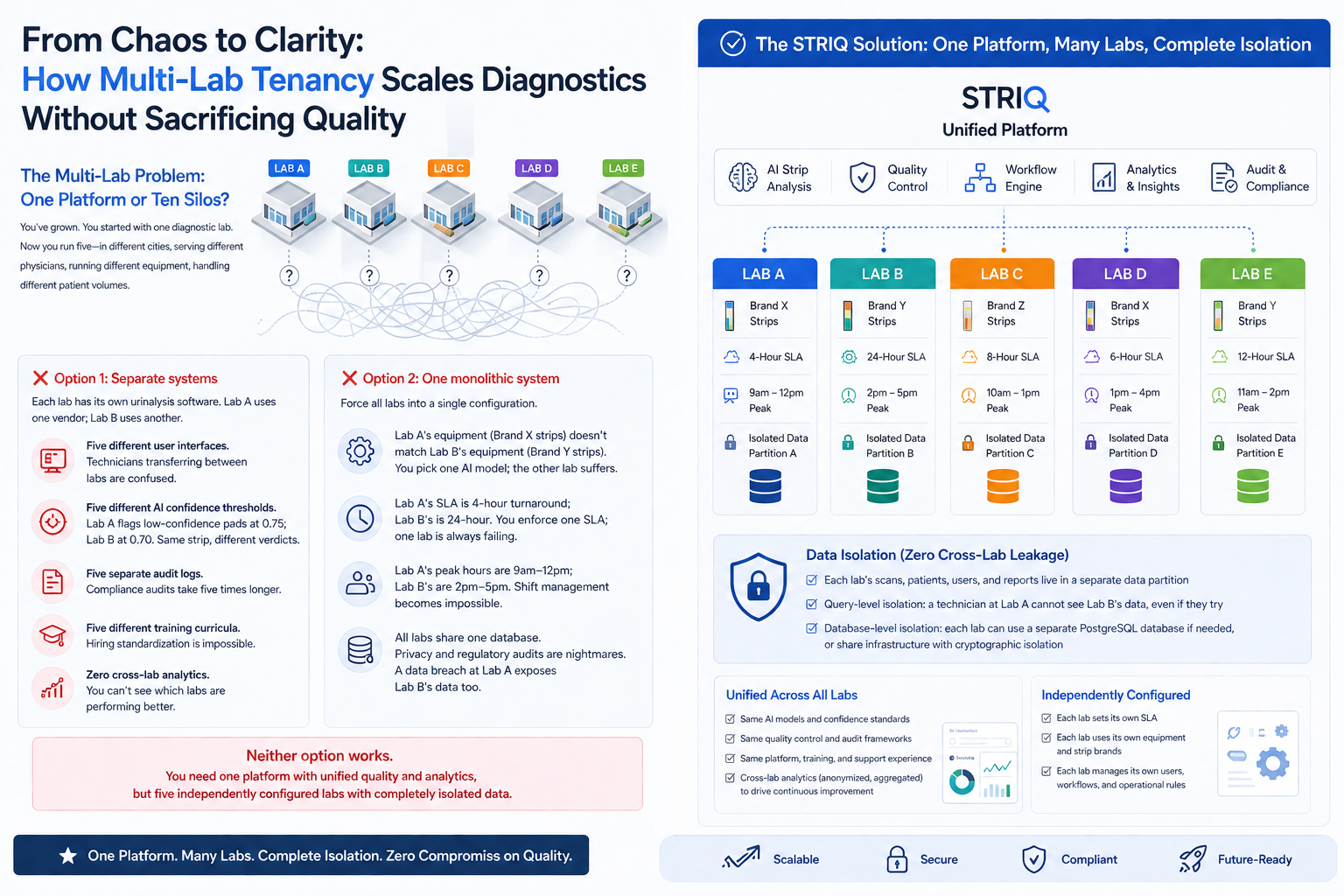
STRIQ is built from the ground up for multi-lab tenancy:
Data isolation (zero cross-lab leakage)
Each lab's scans, patients, users, and reports live in a separate data partition
Query-level isolation: a technician at Lab A cannot see Lab B's data, even if they try
Database-level isolation: each lab can use a separate PostgreSQL database if needed, or share infrastructure with cryptographic isolation
Backup and recovery: each lab's data is backed up independently
Compliance: HIPAA auditors see zero cross-lab data exposure
Unified configuration with lab-specific customization
Platform admins set platform-wide rules:
HIPAA strict mode: ON (all labs)
Minimum confidence threshold: 0.70 (all labs, unless overridden)
Critical-value escalation: enabled (all labs)
2FA for directors: required (all labs)
Lab directors customize per-lab:
Strip brands: Lab A runs Roche 10-pad strips; Lab B runs Siemens 14-pad strips. Each lab deploys the AI models trained on their brand.
SLA times: Lab A: 4-hour turnaround. Lab B: 24-hour turnaround. Separate SLA configs, separate tracking, separate compliance dashboards.
Critical thresholds: Lab A (urban, high-acuity): glucose ≥ 250 = critical. Lab B (rural, screening): glucose ≥ 300 = critical. Different rules, enforced independently.
Shift schedules: Lab A: 24/7 with three shifts. Lab B: 8am–5pm weekdays only. Staffing alerts respect each lab's schedule.
Physician networks: Lab A has 40 referring physicians. Lab B has 12. Each lab manages its own CRM.
Accreditation bodies: Lab A pursues NABL; Lab B pursues CAP. Separate compliance modules, separate documentation.
Unified analytics across labs (with isolation)
Platform superadmin dashboard:
Multi-Lab Analytics | Jan 2024
━━━━━━━━━━━━━━━━━━━━━━━━━━━━━━━━━━━━━━━

Scans Processed (All Labs)
  Lab A: 2,341 scans
  Lab B: 1,856 scans
  Lab C: 891 scans
  Lab D: 1,204 scans
  Lab E: 567 scans
  TOTAL: 6,859 scans

Quality Metrics
  Lab A: 96.3% pass (no manual review needed)
  Lab B: 92.1% pass
  Lab C: 94.7% pass
  Lab D: 95.8% pass
  Lab E: 91.2% pass
  Network average: 94.0%

Outliers
  ⚠ Lab E flagged 18.8% of scans (vs network avg 6.0%)
    → Recommendation: Review AI model training or equipment calibration

Critical Values Escalated
  Lab A: 18 (SLA compliance: 100%)
  Lab B: 14 (SLA compliance: 100%)
  Lab C: 7 (SLA compliance: 100%)
  Lab D: 11 (SLA compliance: 100%)
  Lab E: 5 (SLA compliance: 80% — investigate delays)

Technician Performance (Cross-Lab)
  Top performer: Maria Chen (Lab A) — 847 scans, 97% quality, 0 complaints
  Up-and-coming: James Wilson (Lab C) — 312 scans, 95% quality
  Needs support: David Smith (Lab B) — 421 scans, 88% quality, 3 complaints

Physician Referral Trends
  Lab A's top referrer: Dr. Rajesh Patel (412 referrals, 98% follow-up)
  Lab B's top referrer: Dr. Sarah Martinez (156 referrals, 94% follow-up)
  Network trend: Referrals up 12% YoY across all labs
Lab directors see their own metrics. Platform admins see comparisons (anonymized if needed, or detailed for internal review).
Real-World Multi-Lab Scenarios
Scenario 1: Rapid Expansion (New Lab Acquisition)
You acquire a diagnostic lab in a new city. It runs different equipment, serves different physicians, has different staff. In a traditional setup, you spend 6 months integrating systems.
With STRIQ:
Week 1: Provision new lab in STRIQ. Create users (2 directors, 4 managers, 16 technicians).
Week 2: Configure strip brands, critical thresholds, SLA times specific to that lab.
Week 3: Import historical data (optional). Staff trained on unified UI.
Week 4: Go live. Data is isolated. Workflows are independent. But analytics roll up to your platform dashboard.
Integration time: 3 weeks instead of 6 months.
Scenario 2: Quality Control Across Labs
You notice Lab E's flagging rate is 18.8% (way above 6% network average). Investigation:
Before STRIQ: You send someone to Lab E. They manually review scans. Weeks of investigation. Maybe you find a problem; maybe you don't.
After STRIQ: You query the platform. Compare Lab E's AI readings to other labs on the same strip brand. Pull side-by-side images of flagged vs. passed pads. Discover: Lab E's equipment has a white-balance issue (the camera is dirty). Equipment maintenance, problem solved, flagging rate drops to 5.8%.
Data-driven operations.
Scenario 3: Unified Compliance Audit
An auditor arrives unannounced. They want to audit all five labs simultaneously.
Before STRIQ: You give them five separate systems. Five different interfaces. Five audit trails to cross-reference. Weeks of work. Auditor confusion.
After STRIQ: You generate one compliance report that covers all labs. Auditor sees:
Platform-wide HIPAA controls (MFA, encryption, access logging)
Per-lab critical-value escalation (all within SLA)
Per-lab technician compliance (all trained, certified, performance tracked)
Cross-lab quality metrics (all above minimum thresholds)
Incident history (zero HIPAA breaches, zero patient complaints)
Single dashboard. Clear evidence. Audit finishes faster. No findings.
Scenario 4: Staff Mobility
A star technician from Lab A is promoted to lab manager. They need to manage technicians at Labs B and C.
Before STRIQ: Learn three different systems. Train on three different workflows. Manage three different sets of user accounts.
After STRIQ: One system. One login. One interface. They can view Labs B and C's work queues, approve scans, track KPIs—all from one dashboard.
Operational friction eliminated.
Multi-Lab Tenancy Features in Detail
Data Isolation
Row-level security: every scan record is tagged with lab_id; queries automatically filter to the user's lab
Network isolation (optional): each lab can run on a separate VPC/cloud region
Cryptographic isolation: data encrypted per-lab with separate keys; even database admins can't cross-lab view without explicit key access
Backup segregation: each lab's backups stored independently
Lab-Specific Configuration
Strip brand library: lab directors add/remove brands assigned to their lab
AI model management: platform admins upload brand-specific models; lab directors activate which models to use
SLA definitions: per-lab turnaround time, per-lab escalation rules
User roles: lab directors manage their own staff; no cross-lab user visibility
Critical thresholds: per-lab parameters for what constitutes a critical value
Accreditation module: NABL or CAP or ISO—select per lab
Cross-Lab Analytics (Opt-In)
Platform admins can enable analytics sharing:
Anonymous peer benchmarking: "Your lab's 94% pass rate vs network average 93%"
Named comparisons (internal use): "Lab A outperforming on Glucose detection; investigate why"
Aggregate reporting: "All labs combined: 6,859 scans, 0 HIPAA incidents"
Lab directors always see their own data. Cross-lab visibility is admin-controlled.
Unified User Management
Platform admins:
Create lab directors
Assign labs to directors
Monitor all directors' activities
Lab directors:
Create their own technicians and managers
See only their lab's users
Cannot see other labs' staff
Dashboard Snapshot (Superadmin Multi-Lab View)
STRIQ Platform Dashboard | January 2024
━━━━━━━━━━━━━━━━━━━━━━━━━━━━━━━━━━━━━━━

Labs Active: 5
  Lab A (City) — 2,341 scans, 96.3% quality ✓
  Lab B (Suburbs) — 1,856 scans, 92.1% quality ⚠
  Lab C (Downtown) — 891 scans, 94.7% quality ✓
  Lab D (Harbor) — 1,204 scans, 95.8% quality ✓
  Lab E (Uptown) — 567 scans, 91.2% quality ⚠

Platform Health
  API uptime: 99.97%
  Database: healthy
  Last backup: 2024-01-15 02:00 UTC
  Active users: 187 across all labs

Security & Compliance
  HIPAA strict mode: ON (all labs)
  2FA enforcement: required for directors (100% enabled)
  Data isolation violations: 0
  Audit log events: 127,453
  Last security scan: 2024-01-14 (clean)

Actions Needed
  Lab B: 8 scans pending director approval
  Lab E: Quality metrics below threshold (investigate)
  Password resets: 3 directors overdue for MFA setup
One dashboard. Five labs. Complete visibility. Zero cross-lab data leakage.
Why This Matters
For multi-lab operators: STRIQ lets you grow without fragmenting your operations. One platform, many locations, unified quality.
For lab directors: You have autonomy (set your own SLAs, thresholds, staff). You also have standards (same AI model, same audit trail, same HIPAA controls as every other lab in the network).
For compliance auditors: Multi-lab audits are faster because one platform means one audit trail, one set of access controls, one backup strategy.
For technicians: They learn one system. If they transfer between labs, there's no retraining friction.
For patients: Their data is safer because each lab's data is isolated. A breach at Lab A doesn't expose Lab B.
CTA
Growth shouldn't mean fragmentation. STRIQ gives you one platform that scales to five labs, fifty labs, or five hundred—each one isolated, each one consistent, each one auditable.
[Book a demo] [See how it works]