The Problem: Eyes Aren't Consistent, Neither Are Technicians
You run a diagnostic lab. Every day, technicians hold urine reagent strips under the light, match pad colors to a reference card, and jot down results. It's fast. It's also fragile:
Color matching is subjective. One tech reads "faint blood" as positive; another reads it as negative. Lighting varies. Eyes tire.
Confidence is invisible. Was that blood pad definitely positive, or borderline? There's no score. You don't know who should double-check it.
Audit trails are sparse. A patient's urinalysis comes back with 10 parameters. You have a name on the report, but not a timestamp, not a step-by-step decision log, not the actual image that was read.
Retesting is manual. Patient asks for a second opinion? Technician re-photographs the strip, re-reads it (inconsistently), and you have two conflicting reports from the same sample.
Quality control is reactive. You catch errors after they're released to patients. By then, a clinical decision may have been made.
The faster you read strips, the less certain you are. And consistency—the whole point of a lab—is the first thing to suffer.
The Solution: Precision, Transparency, and an Audit Trail
STRIQ is an AI diagnostic platform for labs. Snap a photo of a reagent strip and our vision pipeline does four things:
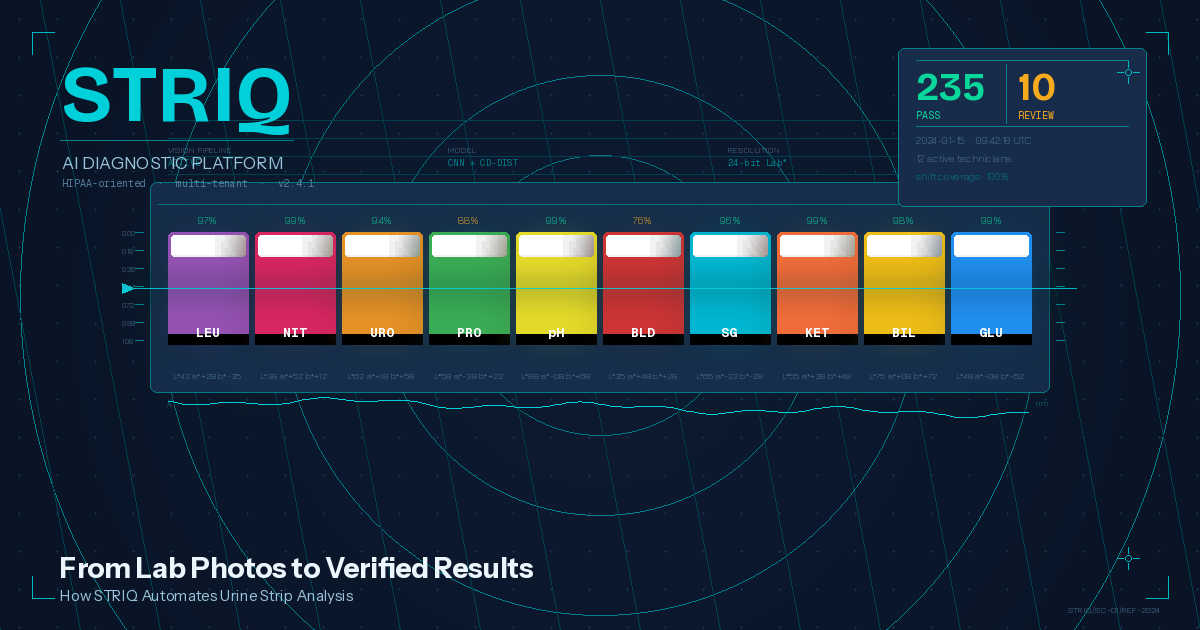
Detects every pad on the strip (auto-correcting image orientation for maximum accuracy).
Measures each pad's precise color in Lab* color space.
Classifies the result using two independent engines: a CNN model and reference color-distance matching.
Fuses and flags the two predictions into a single confidence score; disagreement = automatic flag for manual review.
Result: every strip gets a quality verdict (PASS, REVIEW, or FAIL) and every pad gets a confidence score. A pad marked REVIEW doesn't go silent—it lands on a technician's queue for human verification. Nothing uncertain is released.
The entire process takes seconds. The entire decision log is permanent—timestamped, queryable, and audit-ready.
10 Chemical Parameters, Read Consistently
STRIQ detects:
Leukocytes, Nitrite, Urobilinogen, Protein, pH, Blood, Specific Gravity, Ketones, Bilirubin, Glucose
Each parameter is read the same way by the AI, every time. You configure strip brands (10-pad, 14-pad, etc.); each lab gets the brands assigned to it. The AI knows which pad is which and classifies each with confidence.
Core Capabilities: The Lab Workflow
Intelligent strip analysis
Photo-to-result in seconds: multipart upload, auto-orientation correction, per-pad reading
Confidence on every pad: low-confidence pads individually flagged; requires manual review
Dual-engine accuracy: CNN fused with reference color-distance classification; disagreements surfaced, not hidden
Multi-brand support: configurable strip brands; each lab runs on assigned brands
Manual entry & re-validation: enter legacy data without an image, or request certified re-validation of any scan
Sample intake & technician workflow
Log sample quality (volume, freshness, labeling) at reception
Claim, submit, and flag scans; personal work queue and history
Flag uncertain pads for peer review or escalation
Tiered authorization & quality control
Scans move through technician → manager → director sign-off
QC control runs, pass/fail tracking, and QC trend analysis
Critical-value escalation: structured critical notifications for urgent results
Reflex ordering: accept or decline AI-recommended reflex tests
Lab operations & compliance
Shift & staff management: define shifts, assign technicians, get coverage alerts
Inventory & reagents: reagent lot tracking, low-stock alerts
Equipment maintenance logs, non-conformance records (NCRs), diagnostic test catalog with reference ranges
Physician CRM: directory of referring physicians per lab
NABL accreditation module: compliance actions, assessor visits, status records
Patient complaint handling: receive, track, resolve support complaints
Patient portal
Health dashboard: recent scans, per-scan health scores, upcoming consultations
Reports & trends: full per-pad results, downloadable reports, chemical-parameter trends over time
Teleconsultations: book consultations, view notes, diagnoses, prescriptions
OTP login: passwordless phone sign-in for home and mobile users
Real-World Scenarios
Diagnostic Lab (High Volume)
A 50-technician lab running 300 strips a day. Before STRIQ: technicians hand-read every strip, 15–20% flagged for second opinion. QC trends take a week to compile. After STRIQ: AI reads every strip in seconds, flags ~5% for review, trends are live. Technicians now verify uncertain pads instead of re-reading good ones. Throughput up, errors down, audit trail complete.
Rural/Underserved Clinic
A clinic with one lab tech and a visiting director (once a week). Before STRIQ: the tech reads strips; the director reviews the batch on Friday. Turnaround is slow and risky. After STRIQ: the tech photographs strips, AI reads them, director approves from anywhere (via the portal) in real time. Patient gets results the same day. Critical values escalate immediately.
Quality-Driven Hospital Lab
A hospital system running five labs. Before STRIQ: each lab has its own procedures and confidence levels. Results from Lab A and Lab B are inconsistent (same sample, different answers). After STRIQ: the same AI model runs at all five labs, centrally managed. Results are consistent. Multi-lab analytics show which labs are ahead/behind on quality.
Patient Wellness & Monitoring
A patient enrolled in a 3-month wellness program with monthly urinalysis. Before STRIQ: they get a paper report each time. No trends. After STRIQ: their patient portal shows glucose levels, protein, pH, and specific gravity trending downward (good). They can book a teleconsultation to discuss. Reports are downloadable, shareable with their doctor.
Dashboard Snapshot (Lab Director View)
Today's Summary
━━━━━━━━━━━━━━━━━━━━━━━━━━━━━━━━━━━━━━━
Total scans processed          247
AI reads (PASS)                235
Flagged for review (REVIEW)    10
Manual entry (no image)        2

Pending verification           8
Verified today                239
Awaiting patient report        5

Active technicians             12
Shift coverage                 100%

Top abnormal parameters today
  1. Protein (18 scans)
  2. Glucose (12 scans)
  3. Leukocytes (5 scans)

Critical values escalated      3
  (All within SLA)
At a glance: you know exactly how many strips are in flight, what's flagged and why, who's working, and which clinical parameters are trending abnormal. Everything is traceable: click any scan and see the image, the pad-by-pad AI reading, the technician who verified it, the manager who approved it, and the director's sign-off.
Built for Every Role
RoleWhat they do in STRIQTechniciansRun analyses, work their scan queue, log QC and sample intake, submit results for review.Lab managersManage shifts, inventory, QC trends; authorize or escalate scans; track NCRs and physician CRM.Lab directorsFinal authorization and sign-off, test-catalog management, accreditation, and lab-scoped audit logs.Patients / home usersView reports, health scores, and trends; request re-validation; book consultations via OTP login.Platform adminsProvision labs, manage users and roles, deploy AI models, monitor platform health.
Compliance, Security & Trust
STRIQ is built for regulated labs:
HIPAA-oriented by design: strict-mode toggle, clinical masking on patient reports, immutable append-only audit logs at lab and platform scope
Full traceability: every verification, scan action, critical-value notification is timestamped and queryable; settings changes record the exact diff and author
Strong access control: JWT authentication, OTP with lockout, strict lab-level data isolation on every query
Multi-lab isolation: many labs on one platform, fully isolated data; each lab's data never touches another's
Platform monitoring: request latency, volume telemetry, exception logging feed a superadmin dashboard
Why This Matters
Manual strip reading is a solved problem at scale—if you have unlimited QC budget. STRIQ solves it at any scale:
Removes subjectivity: the AI reads the same way every time, every pad gets a confidence score
Accelerates verification: technicians don't re-read good strips; they only verify the uncertain ones
Builds trust: every decision is logged, traceable, and auditable
Empowers patients: they see their results, trends, and can engage with their health via the portal
Scales without friction: add labs, add technicians, add patients—the platform isolates data and enforces the same quality at every location
CTA
Bring consistency, speed, and an audit trail to every strip. STRIQ gives diagnostic labs an AI reader, a complete verification workflow, and a patient reporting portal in one platform—with the traceability compliance teams expect.
[Book a demo] [See how it works]