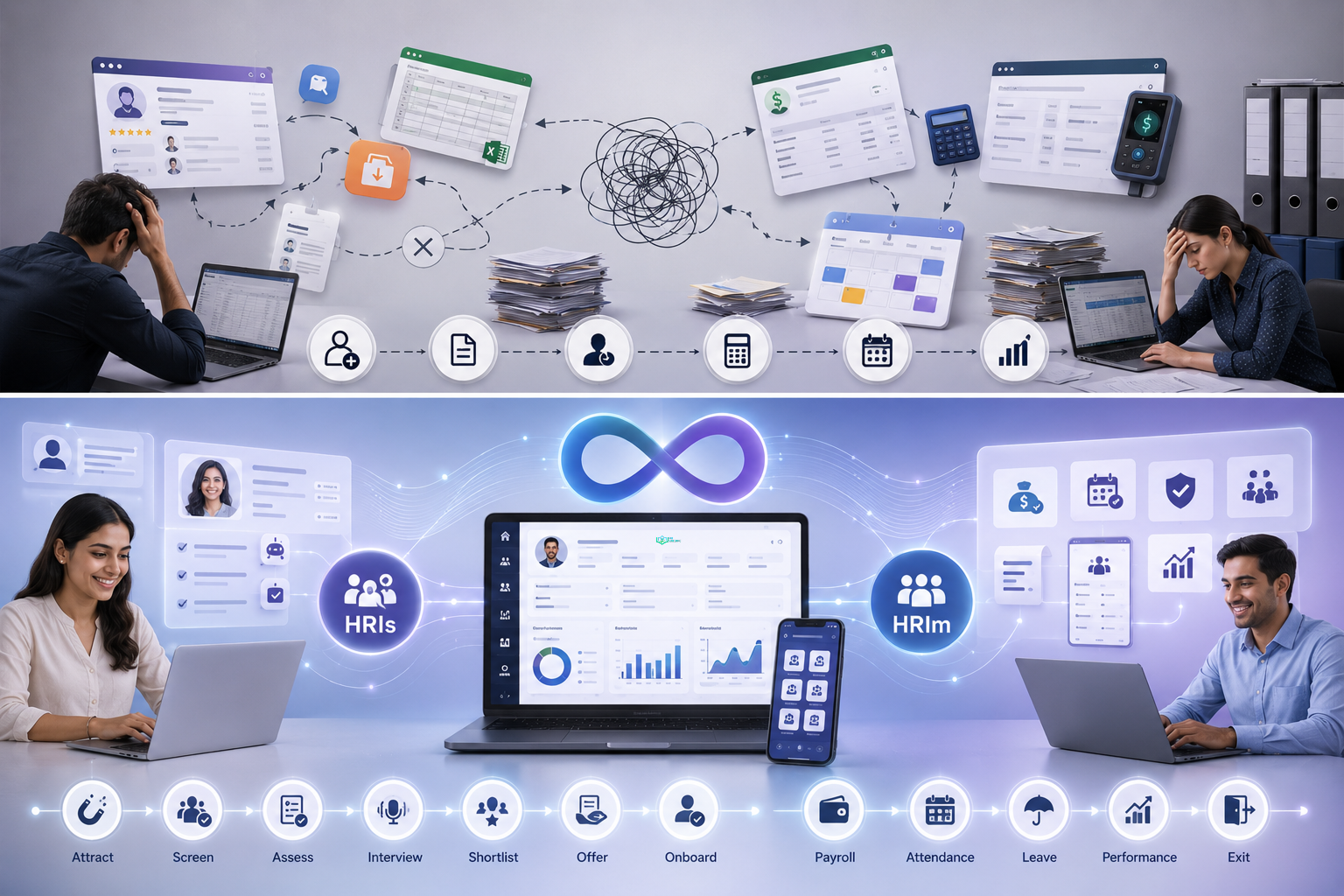
The phrase "hire-to-retire" gets used in every HR software pitch deck. Usually it means: we cover payroll AND have a recruitment tab. Two disconnected modules, one brand name.
The actual hire-to-retire problem is a data continuity problem. And most platforms don't solve it.
Where the gaps live
Think about what happens when a candidate gets hired in a typical company.
The recruiter closes the role in the ATS. HR ops gets an email — name, role, salary details, start date. Someone enters that into the HRIS. Payroll picks up from there. Three systems, two manual handoffs, and the original context — interview scores, assessment results, the conversation that shaped the offer — is already gone.
By the time the employee completes their first appraisal, no one can trace the arc from "applicant" to "top performer." There's no thread.
HRI is the thread
HRI is built on the premise that the employee record should be continuous, not fragmented. The same record that tracks a candidate through HRIs screening — their scores, interview transcript, assessment performance — becomes the employee record in HRIm the moment they're hired.
No re-entry. No data loss. The context carries forward.
What each stage looks like
The five stages of the HRI lifecycle are:
Attract & Screen — AI ranks applicants by role-fit as they apply.
Interview & Assess — Conversational AI interviews and proctored assessments run async, at scale.
Offer & Onboard — The selected candidate converts to a live employee record.
Pay & Comply — Payroll runs with attendance, leave, and India statutory compliance built in.
Perform & Retain — OKRs, 360° reviews, and lifecycle analytics close the loop.
Each stage is in the same system. The data from stage 1 is visible at stage 5.
Why this matters for HR strategy
When your hiring tool and HR operations platform share one record, you can start asking questions that fragmented systems can't answer: Do candidates who scored higher in assessments perform better at 12 months? Which hiring sources produce employees who stay? Where does attrition cluster in the lifecycle?
These aren't questions for a BI tool bolted onto three databases. They're questions that require a single, unbroken data thread from application to appraisal.
HRI is that thread.
Start anywhere
You don't have to implement both products at once. Start with HRIs if hiring is your bottleneck. Start with HRIm if compliance and payroll are the immediate pain. They share one record and one login — so whichever half you start with, the other is ready to connect when you need it.
The lifecycle is the product. HRI just makes it one system.